Quick Answer
Website speed affects how quickly users can access and interact with your site, which directly influences both SEO and conversions. Fast-loading websites improve user experience, increase engagement, and help rankings in search results, while slow websites can lead to higher bounce rates and lost leads.
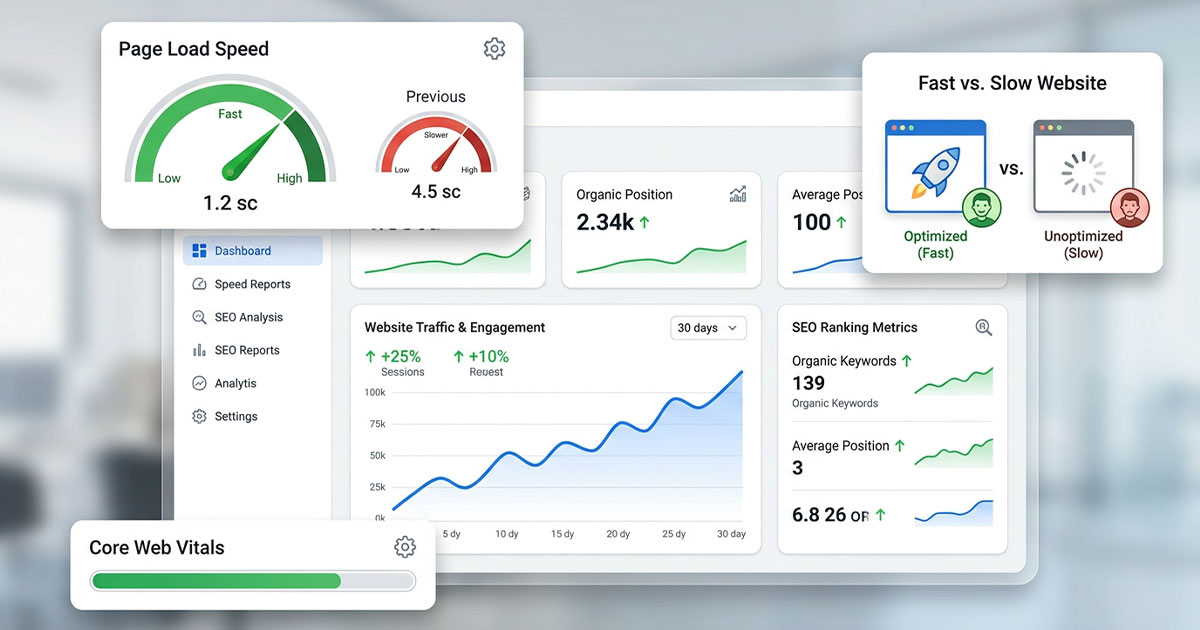
Website speed is one of the most important factors in digital performance.
A slow website can negatively impact user experience, reduce engagement, and limit conversions. At the same time, search engines consider page speed as a ranking factor, making it critical for visibility.
Businesses that optimize their website speed improve both their search performance and their ability to convert visitors into customers.
To understand how performance fits into the bigger picture, explore our complete guide to website design that converts visitors into customers.
What Is Website Speed?
Website speed refers to how quickly a webpage loads and becomes usable for visitors.
This includes:
- how fast content appears
- how quickly users can interact with the page
- how smoothly the site functions
Speed is measured using performance metrics such as load time, page responsiveness, and visual stability.
Why Website Speed Matters for SEO
Search engines prioritize websites that provide a better user experience. Page speed is a ranking factor because it affects how users interact with a site.
Faster websites tend to:
- rank higher in search results
- receive more organic traffic
- have better engagement metrics
Search engines also consider how quickly content loads on mobile devices. To understand how structure and performance connect, read The Role of Content Structure in SEO and AEO.
How Website Speed Impacts Conversions
Website speed has a direct impact on whether users take action. When a website loads quickly, users are more likely to stay engaged. When it loads slowly, users often leave before interacting with the page.
Speed influences:
• bounce rates
• time on page
• conversion rates
Faster websites create a smoother experience that encourages users to complete actions.
The Connection Between Speed and User Experience
User experience is heavily influenced by performance. A fast website feels responsive and easy to use. A slow website creates frustration and uncertainty.
Key UX benefits of fast websites include:
- quicker access to information
- smoother navigation
- improved engagement
To understand how user experience drives results, read What Makes a High-Converting Website.
Mobile Performance and Speed
Mobile users expect fast load times. If a website is not optimized for mobile speed, it can lead to poor performance and lost opportunities.
Mobile optimization includes:
- responsive design
- optimized images
- efficient code
- reduced load times
Search engines prioritize mobile-friendly websites, making this a critical factor.
Common Causes of Slow Website Speed
Several factors can reduce website performance.
Common issues include:
- large image files
- excessive scripts and plugins
- poor hosting performance
- unoptimized code
- lack of caching
Identifying and addressing these issues can significantly improve speed.
How to Improve Website Speed
Improving website speed requires a combination of technical and design strategies.
Businesses can optimize performance by:
- compressing images
- reducing unnecessary scripts
- using reliable hosting
- enabling caching
- optimizing code structure
Regular performance testing helps identify areas for improvement.
Website Speed and Landing Pages
Landing pages rely heavily on speed to convert traffic. Users arriving from ads or search results expect immediate access to information. Slow landing pages can reduce conversion rates and increase cost per lead.
To understand how landing pages drive results, read Landing Page Optimization: How to Turn Traffic into Leads.
Website Speed and AI Search
AI-driven search systems also consider user experience signals.
Websites that perform well are more likely to be included in:
- featured snippets
- AI-generated summaries
- answer-based search results
Performance supports both visibility and engagement.
To understand how visibility works in modern search, explore How Businesses Can Appear in AI Search Results.
Services That Improve Website Performance
At PG38 Creative, we build websites that are optimized for both speed and performance.
Our approach focuses on creating systems that support visibility, engagement, and conversions.
Explore our Website Design services to learn how we help businesses improve website performance.
Frequently Asked Questions
Why is website speed important?
Website speed affects user experience, search rankings, and conversion rates.
Does website speed impact SEO?
Yes. Search engines use page speed as a ranking factor.
How does speed affect conversions?
Faster websites reduce bounce rates and increase the likelihood of users taking action.
What slows down a website?
Common causes include large images, excessive scripts, and poor hosting.
Conclusion
Website speed plays a critical role in both search visibility and conversion performance. Businesses that invest in optimizing speed create better user experiences and improve their ability to generate results.
By focusing on performance, businesses can increase engagement, improve rankings, and turn more visitors into customers.
To see how speed fits into a complete strategy, revisit our complete guide to website design that converts visitors into customers.
About PG38 Creative
Marketing Strategies Built for Growth
PG38 Creative helps businesses grow through strategic marketing, creative content, and advanced search visibility. Our team specializes in website design, video marketing, paid advertising, and modern search strategies like SEO and Answer Engine Optimization (AEO).
We help companies build systems that attract customers, generate leads, and create long-term brand visibility.